
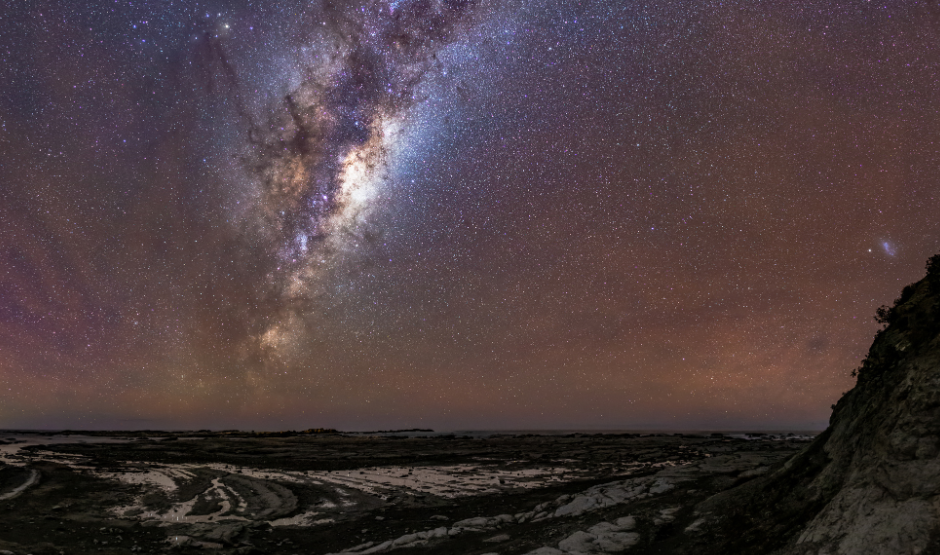
Kaikōura has been officially designated as an International Dark Sky Sanctuary, making it one of the most exceptional places in New Zealand—and indeed the world—to experience the profound wonders of the night sky. This prestigious recognition acknowledges what the region’s pristine environment has offered for centuries: a window into the cosmos unmarred by light pollution, where the ancient rhythms of the heavens remain visible in all their glory.
Here, away from the intrusive glare of city lights, the stars shine with an unparalleled clarity that takes your breath away. Thousands upon thousands of celestial points illuminate the darkness, revealing the Milky Way in stunning detail as it arcs across the sky like a luminous river. This creates the perfect setting for Matariki star gazing, where the ancient stories and traditions of the Māori sky come to life against a backdrop of breathtaking celestial views that have guided and inspired for generations.
Experience Matariki in Kaikōura’s Dark Skies
Matariki, the Māori New Year, holds profound significance as both a cultural touchstone and a celestial event. When the Matariki star cluster—known in the West as the Pleiades—rises in the mid-winter sky, it signals the beginning of the Māori new year, traditionally marking a time of reflection on those who have passed, celebration of the present, and preparation for the future. This ancient tradition connects us to the rhythms of nature and the wisdom of ancestral knowledge, reminding us that we are part of something far greater than ourselves.
In Kaikōura, the observation of Matariki takes on a special dimension. The region’s designation as an International Dark Sky Sanctuary means that the Matariki cluster appears with remarkable brilliance, its seven visible sisters shining clearly in the northeastern sky. According to Māori tradition, each of these stars holds its own significance: Matariki herself represents reflection and hope; Pōhutukawa connects to those who have died; Waitī and Waitā are associated with fresh and saltwater food sources; Waipuna-ā-Rangi links to rain; Tupu-ā-Nuku connects to food from the land; and Tupu-ā-Rangi relates to food from the trees.
The coastal location of Kaikōura adds another layer of meaning to Matariki observations. As a place where the mountains meet the sea, where diverse ecosystems converge, and where the land reaches dramatically skyward, Kaikōura embodies the connection between earth and sky that Matariki represents. The rising of the star cluster over the Kaikōura ranges, with the Pacific Ocean stretching endlessly to the east, creates a viewing experience that connects observers to both the terrestrial and celestial worlds.
The Cultural Significance of Matariki
Matariki is far more than just a celestial phenomenon—it’s a time of profound cultural and spiritual importance. Traditionally, the appearance of Matariki signaled the beginning of the harvesting season, a time to gather crops, preserve food, and prepare for winter. It was also a time for whānau (family) to come together, to remember ancestors, to tell stories, and to pass down knowledge from one generation to the next.
The Matariki season encourages us to reflect on the past year: what we’ve learned, how we’ve grown, and those we’ve lost. It’s a time to appreciate the present moment, to express gratitude for the abundance in our lives, and to strengthen bonds with family and community. Looking forward, Matariki inspires us to set intentions, to plant seeds—both literal and metaphorical—and to embrace new beginnings with hope and determination.
In contemporary New Zealand, Matariki has experienced a beautiful renaissance, with people from all backgrounds embracing this indigenous celebration. Communities across the country now mark Matariki with festivals, concerts, traditional kai (food) preparations, storytelling, and of course, star gazing. Kaikōura, with its exceptional dark skies and deep connection to both land and sea, offers one of the most authentic and awe-inspiring settings for this celebration.
Witnessing Matariki’s Magic
As the sun dips behind the towering Kaikōura ranges, the transformation begins. The sky shifts through shades of deep blue to indigo, and then, seemingly all at once, the stars emerge. First come the brightest—perhaps Jupiter or Venus—followed by an ever-increasing cascade of stellar light until the entire sky is ablaze with thousands of stars, their ancient light traveling across unimaginable distances to reach your eyes at this precise moment.
For those seeking to witness Matariki in Kaikōura, the experience is nothing short of transcendent. Whether you’re an avid astronomer with telescopes and star charts, or simply someone seeking a moment of quiet reflection under a starlit sky, Kaikōura’s dark skies offer an unforgettable experience. Every glance upward becomes a reminder of the universe’s endless wonder, of our small but meaningful place within it, and of the traditions that connect us across time.
The International Dark Sky Sanctuary designation means that Kaikōura is committed to preserving this precious resource, ensuring that future generations will continue to experience the night sky as our ancestors did—full of wonder, meaning, and possibility. For those planning a visit during Matariki season, comfortable accommodation options are available, allowing you to extend your star gazing experience across multiple nights and fully immerse yourself in this special time of year, when the ancient and the eternal converge in the crystalline skies above Kaikōura.